


Modern power distribution networks face growing demands as cities expand, commercial and industrial facilities consume more electricity, EV charging infrastructure develops, and renewable energy becomes more widely integrated into the grid. These changes require distribution systems to handle diverse loads while maintaining reliable and efficient power delivery.
A Power Transformer plays an essential role in this process by adjusting voltage levels to meet the requirements of different stages of electricity distribution and end-use applications. Pad-mounted transformers are particularly useful in underground distribution networks, where their enclosed, ground-level design supports power delivery to residential communities, commercial buildings, and industrial facilities.
Understanding how pad-mounted transformers work helps project developers and electrical professionals make informed equipment decisions. This article explores their core functions, key benefits, design and compliance requirements, installation and maintenance practices, and the factors to consider when selecting a suitable transformer for modern power distribution systems.

1. What Are Pad-Mounted Transformers?
1.1 Definition and Function
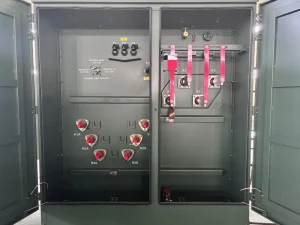
A Pad Mounted Transformer is an enclosed distribution transformer installed on a concrete pad at ground level. It reduces medium-voltage electricity to usable levels for local distribution. Unlike pole-mounted transformers installed overhead, pad-mounted units are commonly used with underground cables, while substation transformers serve larger power distribution networks.
1.2 Single-Phase vs. Three-Phase
Single-phase units: Often serve residential areas and smaller loads.
Three-phase units: Commonly support commercial buildings, industrial facilities, and higher-capacity applications.
The right configuration depends on voltage, capacity, and load requirements.
1.3 Common Applications
Pad-mounted transformers support power distribution in:
- Residential communities and urban developments
- Commercial buildings and business parks
- Industrial plants and manufacturing facilities
- Data centers and EV charging infrastructure
- Renewable energy and distributed power projects
2. Key Benefits of Pad-Mounted Transformers
2.1 Safety and Accessibility
Enclosed cabinets, locking mechanisms, and separate high- and low-voltage compartments help limit public access to energized components. Safe operation also depends on proper installation, maintenance, and site management.
2.2 Space and Appearance
Ground-level designs fit residential communities, commercial parks, and urban developments. Combined with underground cables, they reduce reliance on overhead lines and help keep public spaces visually organized.
2.3 Reliability and Protection
Appropriate load sizing, corrosion-resistant enclosures, and suitable moisture protection support reliable operation. For an Oil Immersed Transformer, insulating oil provides electrical insulation and helps dissipate heat. Flood protection and oil containment should match site conditions.
2.4 Maintenance and Lifecycle Costs
Accessible installation simplifies routine inspections. Regular maintenance helps identify developing issues, while lifecycle cost assessments should consider purchase price, energy losses, maintenance expenses, and expected service life.

3. Design and Compliance
Transformer design and compliance requirements vary by project. Buyers should verify equipment specifications against local regulations, utility requirements, and the intended operating environment.
3.1 Components and Standards
| Area | Key Considerations |
| Core and windings | Voltage conversion and rated capacity |
| Compartments | High- and low-voltage separation |
| Insulation and cooling | Dielectric performance and heat dissipation |
| Enclosure and protection | Materials, corrosion resistance, and environmental conditions |
| Standards and efficiency | Applicable UL, cUL, IEEE, CSA, ANSI, and DOE requirements |
3.2 Selecting the Right Configuration
When specifying a Three Phase Pad Mounted Transformer, confirm primary and secondary voltages, capacity, load characteristics, and connection requirements. Cooling options, noise limits, flood exposure, and enclosure protection should also match site conditions.
Certifications, technical standards, and energy-efficiency regulations serve different purposes. Verify their applicability to the specific unit and project before purchase.
4. Installation, Maintenance, and Smart Distribution
4.1 Installation Planning
Proper site planning should account for:
- A stable foundation, drainage, grounding, and safe access
- Adequate ventilation, maintenance clearance, and safety distances
- Flood risks, ambient temperatures, corrosion, load centers, and cable routes
4.2 Inspection and Maintenance
Follow manufacturer guidance and applicable codes when scheduling inspections. Check for abnormal temperatures, loose connections, enclosure corrosion, insulation issues, and protection device faults. Infrared scanning and oil analysis can help assess equipment condition when appropriate.
4.3 Smart Grids and New Loads
Online monitoring and condition-based maintenance support smarter distribution networks. EV charging, solar generation, energy storage, and data centers also influence transformer capacity and configuration. Underground distribution suits many urban developments, while overhead lines can be practical where routing and site conditions favor them. A Pole Mounted Transformer serves overhead distribution, unlike pad-mounted equipment designed for ground-level installation with underground cables.
5. Choosing a Transformer Supplier
5.1 Technical Fit and Compliance
Check rated voltage, capacity, phase, connections, and environmental requirements. Verify that certifications and technical documents match project specifications. Choose a single-phase pad-mounted transformer or three-phase unit based on actual load requirements, not application type alone.
5.2 Experience and Support
Assess the supplier’s familiarity with U.S. and Canadian project requirements. Review technical guidance, documentation, delivery schedules, warranty terms, and after-sales support. Compare total ownership costs, including energy efficiency and maintenance, rather than purchase price alone.
Conclusion
Pad-mounted transformers support modern power distribution by converting voltage, enabling underground cable networks, and providing enclosed equipment that makes efficient use of space. Correct equipment selection, standards compliance, proper installation, and preventive maintenance are essential for reliable long-term operation. As EV charging, renewable energy, energy storage, and data centers expand, transformer specifications must also match changing load demands and site conditions.
QXG offers single-phase and three-phase pad-mounted transformers, substation transformers, and other distribution solutions, backed by UL/cUL certifications and project experience across the U.S., Canada, and Latin America. Its regional after-sales teams support customers in the U.S. and Canada. Contact QXG to discuss your pad-mounted transformer requirements and request a project-specific quote.