


From rural roads and farms to residential neighborhoods and small businesses, reliable electricity is essential to daily life. Behind this power supply, pole-mounted transformers play a key role in overhead distribution networks, helping deliver electricity from utility lines to homes, commercial buildings, and community facilities.
By stepping down medium-voltage electricity to usable low-voltage levels, these transformers connect local distribution lines with end users. Their installation on utility poles makes them suitable for many areas where overhead power lines are practical, supporting community growth without requiring extensive underground infrastructure.
Understanding how pole-mounted transformers work helps utilities, contractors, and project developers make informed decisions. This article explores their applications, operating principles, design requirements, maintenance practices, and key considerations when selecting a transformer.
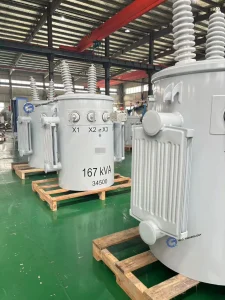
1. What Are Pole-Mounted Transformers?
1.1 Definition and Function
A pole mounted transformer is a distribution transformer installed on a utility pole to reduce medium-voltage electricity to levels suitable for local use. It connects overhead distribution lines to homes, businesses, farms, and other end users, helping deliver power across communities.
1.2 Single-Phase vs. Three-Phase
The right configuration depends on load requirements and the distribution system.
| Type | Typical Loads | Common Applications |
| Single-phase | Lighting, appliances, small loads | Homes, rural areas |
| Three-phase | Motors, HVAC, larger loads | Commercial buildings, industrial facilities |
Single-phase units commonly serve residential and low-demand areas, while three-phase units support larger or more complex loads. Final selection should consider voltage, capacity, and project specifications.
2. How Pole-Mounted Transformers Power Communities
2.1 Rural and Residential Areas
An overhead distribution transformer helps deliver electricity to rural homes, remote communities, and expanding suburbs. Overhead lines connect dispersed customers to the local grid, while pole-mounted units step down voltage near the point of use.
2.2 Commercial and Community Facilities
These transformers can supply farms, irrigation systems, shops, schools, communication facilities, and small industrial users. Capacity and configuration should match expected loads, equipment requirements, and the distribution network.
2.3 Cost and Installation
Overhead distribution can reduce the need for underground excavation and extensive civil works, making it practical in some locations. However, overall costs depend on terrain, pole infrastructure, labor, maintenance access, and local codes. Project planners should compare overhead and underground options before choosing a solution.
3. How Pole-Mounted Transformers Work
3.1 Voltage Conversion
A single phase pole mounted transformer uses electromagnetic induction to reduce distribution-line voltage to a level suitable for local use. Its core transfers magnetic flux between the primary and secondary windings.
3.2 Components and Protection
| Component | Function |
| Core and windings | Transfer energy and change voltage |
| Tank and insulating oil | Provide insulation and dissipate heat |
| Bushings | Connect internal windings to external circuits |
| Fuses | Interrupt certain overcurrent faults |
| Surge arresters | Limit damaging voltage surges |
Protection configurations vary by model. External fuses and surge arresters are common, while some units offer additional integrated protection. Buyers should verify the supplied configuration against utility requirements and project specifications.
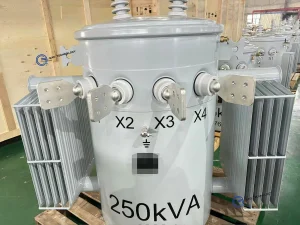
4. Design, Standards, and Outdoor Performance
4.1 Capacity and Configuratio
A three phase pole mounted transformer should be selected according to calculated load demand and project specifications, rather than community size alone.
4.2 Outdoor Protection
| Design Factor | Key Consideration |
| Capacity and voltage | Expected load and system ratings |
| Connections | Phase and wiring requirements |
| Environment | Temperature, moisture, corrosion, and wind |
| Physical protection | Enclosure, insulation, and wildlife exposure |
| Compliance | Applicable certifications and efficiency rules |
4.3 Standards and Certifications
UL/cUL relate to product safety certification, while IEEE, CSA, and ANSI publish technical standards. U.S. Department of Energy (DOE) requirements may apply to transformer energy efficiency. These serve different purposes, so buyers should verify the specific model’s documentation and applicable project, utility, and regulatory requirements before purchase.
5. Installation, Maintenance, and Future Grid Needs
5.1 Installation and Safety
Installation requires adequate pole strength, proper grounding, safe clearances, accessible maintenance space, and compliance with local codes. Qualified professionals should handle installation and servicing.
5.2 Inspection and Maintenance
A pole mounted transformer maintenance Canada plan should follow manufacturer guidance, equipment condition, and applicable regulations. Inspections should check for oil leaks, abnormal temperatures, damaged bushings, loose connections, corrosion, and protection-device issues.
5.3 Smart Grids and New Loads
Online monitoring and condition-based maintenance can help identify developing faults. EV charging, renewable energy, and battery storage also affect load planning and transformer selection. Pole-mounted units serve overhead networks, while pad-mounted units commonly support underground distribution. The right choice depends on grid design, available space, safety requirements, and site conditions.
Conclusion
Pole-mounted transformers play an important role in community power distribution by reducing voltage for local use and connecting overhead lines to homes, farms, and businesses. Their effectiveness depends on selecting the right capacity and configuration, meeting applicable standards, ensuring safe installation, and following a suitable preventive maintenance plan. As communities grow and electricity demand changes, careful transformer planning helps support reliable power delivery.
QXG supplies pole-mounted, pad-mounted, and substation transformers, backed by UL/cUL certifications, over 10 years of market experience across the U.S., Canada, and Latin America, and after-sales teams in the U.S. and Canada. Contact QXG with your voltage, capacity, phase, and project requirements to discuss a suitable solution and request a project-specific quote.