


In many residential neighborhoods, commercial centers and industrial parks across North America, you may notice green or gray metal cabinets installed at ground level beside roads, buildings or landscaped areas. These seemingly ordinary enclosures are an important part of local power distribution infrastructure, quietly converting electrical energy into usable power for nearby homes, businesses and facilities.
These cabinets are pad-mounted transformers, designed specifically for ground-level installation and underground cable networks. They combine voltage transformation with an enclosed structure, appropriate electrical configurations and built-in protection features to provide safe, reliable and practical power distribution for residential, commercial and industrial environments.
This guide explores pad-mounted transformers from the fundamentals to practical applications. It explains how they work, introduces major types and configurations, examines their key functions and common applications, and outlines essential maintenance and selection considerations for different power distribution projects.
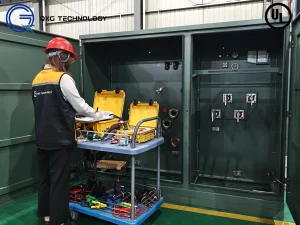
1. What Is a Pad-Mounted Transformer?
A pad-mounted transformer is a ground-level distribution transformer enclosed in a lockable, tamper-resistant steel cabinet and installed on a concrete pad. Unlike pole-mounted transformers, it connects to underground cables rather than overhead lines, making it ideal for developed areas where safety, appearance and efficient use of space are important, such as:
- Urban and suburban residential areas
- Commercial complexes
- Industrial facilities requiring underground power distribution
Depending on project requirements, its capacity can range from small residential units to large distribution transformers, with both single-phase and three-phase configurations available.
2. How Does a Pad-Mounted Transformer Work?
A Pad-mounted distribution transformer works through electromagnetic induction. AC entering the primary winding creates a magnetic field in the transformer core, which induces voltage in the secondary winding. The turns ratio determines how much the voltage is reduced.
Key Processes
- Voltage conversion: High primary voltages such as 12.47 kV, 13.2 kV or 34.5 kV are stepped down to usable secondary voltages such as 120/240 V or 480/277 V.
- Insulation and cooling: Mineral oil or environmentally friendly FR3 fluid provides both electrical insulation and heat dissipation for internal components.
- Fault protection: Fuses, load-break switches and elbow connectors help isolate faults and support safer maintenance.
Together, these systems enable reliable voltage transformation and power distribution in underground networks.

3. Types of Pad-Mounted Transformers
Pad-mounted transformers can be categorized from two perspectives: phase configuration and feed arrangement. Phase configuration determines the type of electrical distribution, while feed arrangement describes how the transformer connects to the power network. The following table summarizes the main options and their typical uses.
| Classification | Type | Key Details | Typical Applications |
| Phase Configuration | Single-Phase | 10-5,000 kVA; typically 120/240 V; compact and cost-effective | Residential areas, apartment complexes, small commercial buildings, schools |
| Phase Configuration | Three-Phase | 75-10,000 kVA; commonly 480/277 V or 208/120 V; suited to higher power demands | Factories, industrial facilities, data centers, shopping centers, renewable energy projects |
| Feed Arrangement | Radial Feed | Single power source; simple system structure and lower installation cost | Projects where straightforward power distribution is sufficient |
| Feed Arrangement | Loop Feed | Two power sources; provides redundancy and greater supply continuity | Projects requiring higher reliability and continued service during maintenance or circuit isolation |
4. Key Functions of Pad-Mounted Transformers
Pad-mounted transformers do more than reduce voltage. They integrate voltage conversion, underground power distribution and equipment protection in one enclosed unit, helping deliver electricity safely and efficiently to different types of users.
Core Functions
- Voltage Step-Down: Converts high distribution voltage into safe, usable levels.
- Safe Distribution: Delivers power to local loads while supporting stable system operation.
- Underground Integration: Connects directly with buried cables where overhead lines are unsuitable.
- Tamper Protection: Grounded steel enclosures and lockable hardware help prevent unauthorized access.
- Fault Protection: Fuses and switches help isolate overloads and faults.
- Loss Reduction: Efficient transformation helps minimize power losses during distribution.
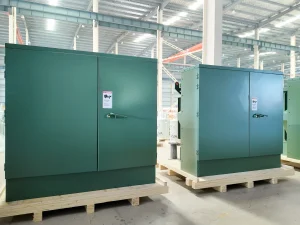
5. Applications of Pad-Mounted Transformers
Pad-mounted transformers are widely used wherever electricity must be distributed through underground networks. Their enclosed, ground-level design makes them suitable for both public and private infrastructure.
Common Applications
- Residential Areas: Supply safe, efficient power to urban and suburban neighborhoods where overhead lines are undesirable.
- Commercial Developments: Serve shopping centers, office complexes and schools with varying electrical loads.
- Industrial Facilities: Three-phase units support factories, manufacturing plants and data centers with higher power demands.
- Renewable Energy Projects: Help step down power from solar and wind facilities for connection to the grid.
- Utility Networks: Enable utilities to distribute electricity efficiently through underground distribution systems.
From local neighborhoods to large industrial and renewable-energy projects, pad-mounted transformers provide a practical solution for reliable underground power distribution.
6. Pad-Mounted Transformer Maintenance
Regular maintenance helps identify potential defects before they develop into costly failures. A practical maintenance program should cover the transformer itself, its protective devices and the surrounding installation area.
Key Maintenance Tasks
- Oil Testing: Check moisture, acidity, dielectric strength and dissolved gases in mineral oil or FR3 fluid to assess insulation and fluid condition.
- Visual Inspection: Look for oil leaks, corrosion, damaged gaskets and signs of unauthorized access.
- Thermal Scanning: Use infrared imaging to identify abnormal hot spots caused by overloading or loose connections.
- Site Cleaning: Keep the transformer and surrounding area clean and vegetation-free to support proper ventilation and heat dissipation.
- Protection Testing: Periodically test switchgear and fuses to verify reliable fault isolation when abnormal conditions occur.
- Grounding Checks: Verify ground resistance and bonding connections to maintain effective electrical safety and fault-current paths.
Conclusion
Pad-mounted transformers play a key role in modern underground power distribution by combining voltage transformation, safe power delivery and equipment protection in a compact ground-level design. Understanding the differences between single-phase and three-phase units, as well as radial- and loop-feed configurations, helps users select suitable equipment for residential, commercial, industrial and renewable-energy applications. Regular oil testing, visual inspection, thermal scanning, protection testing and grounding checks further support reliable long-term operation.
For utilities, contractors and project developers, choosing the right transformer partner is equally important. QXG Technology provides reliable transformer solutions backed by more than 10 years of experience in the USA, Canada and Latin America, with expertise in IEEE, CSA, ANSI and DOE standards. Contact QXG for transformer solutions tailored to your project requirements.