


How Do Pad-Mounted Transformers Achieve Greater Reliability and Safety? The Answer Lies in Their Standard Features.
From tap changers to protective fuses, each built-in accessory plays a critical role in safeguarding the stability of the power system. This article will explore how these “standard components” work behind the scenes to ensure the transformer’s long-term efficiency and durability, as well as the overall safety and security of the electrical grid.
Fuses
Fuses function as a primary safety mechanism by melting (blowing) and breaking the circuit in response to dangerously high currents or temperatures, thereby isolating an individual transformer from the system.
Pad-mounted transformers commonly feature a dual-fuse protection scheme, utilizing both Bay-O-Net fuses and current-limiting fuses. The Bay-O-Net fuse serves as the primary protection—an easily replaceable expulsion fuse designed for initial response. Acting as a second-line defense, the current-limiting fuse provides backup protection specifically against high-level faults. This combined approach creates a highly effective and reliable protection system.

High/ Low voltage bushings
A transformer bushing is an insulating component that allows an electrical conductor to pass safely through the transformer tank while providing electrical isolation. It serves as an insulated pathway for current to enter or exit the transformer.
Bushings are designed to operate at different voltage levels.
High-voltage bushings withstand greater electrical stress and typically use multi-layer insulation such as oil to manage voltage distribution and prevent discharge.
Low-voltage bushings are commonly made from epoxy resin or polymer materials and are used where lower voltage and current levels are present.
Tap changer
A transformer tap changer is a rotary switching device designed to regulate output voltage by adjusting the number of active turns in the transformer winding—typically on the high-voltage (primary) side. By physically modifying the winding ratio, it ensures the secondary voltage remains within specified limits, compensating for input voltage fluctuations or load variations. This function is essential for maintaining stable power quality, reducing system losses, and extending the operational life of connected electrical equipment.
Load break switch
The transformer load break switch installed in the high-voltage room serves essentially as the transformer’s “energized operation switch.” Its core function is to allow operators to safely make or break load current while the transformer remains energized, enabling switching operations under load conditions.
This type of switch is primarily categorized into two configurations: two-position switches and four-position switches.
Pressure vacuum gauge
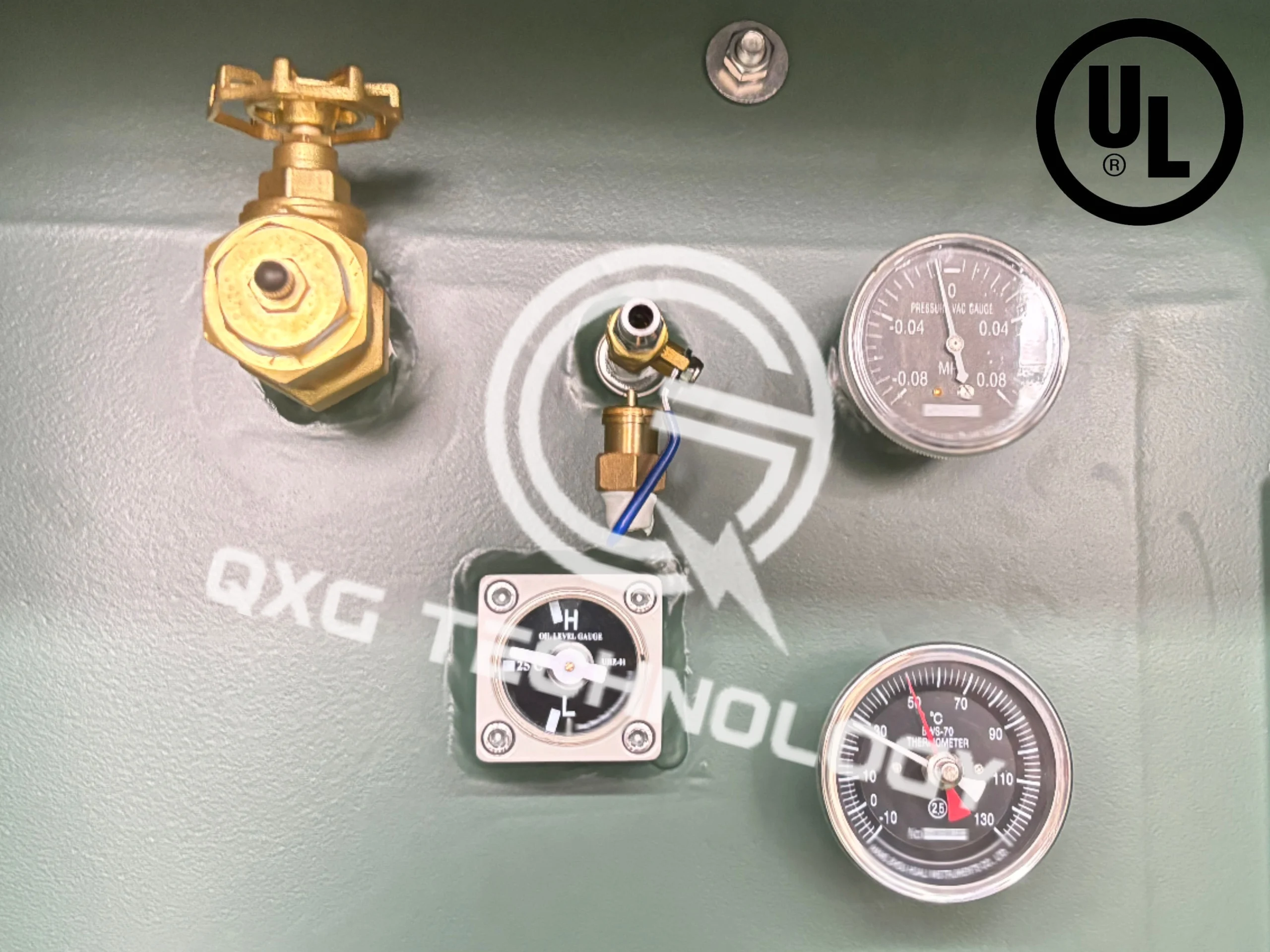
During normal operation, the inside of the transformer is in a relatively sealed state, and its pressure should be within a certain range. The pressure vacuum gauge is used to monitor the pressure inside the transformer tank. When the transformer tank becomes hot or cool, the pointer on the vacuum pressure gauge dial will move accordingly.
Temperature indicator
The temperature indicator. The red pointer on the temperature indicator is the highest liquid level indicator, showing the maximum operating temperature of the transformer. The transformer will generate heat in the process of normal load operation, and the temperature indicator is used to monitor the transformer temperature in real time, provide intuitive data for maintenance personnel, and facilitate maintenance personnel to specify a reasonable maintenance plan.

Oil level gauge
In the low voltage room, this is the oil level indicator. The oil level indicator is used in the transformer to visually display the oil level in the transformer tank. A buoy is placed inside the transformer to mark the position of the buoy on the transformer oil surface. There is a 25 ° Celsius mark on the surface of the oil level gauge, which serves as a reference mark for the transformer temperature. Because the oil will change due to temperature change, leakage and other reasons during the operation of the transformer, the abnormal fluctuation of the oil level can be found in time through the oil level guage.
Pressure relief valve
The standard pressure relief valve on most pad mounted transformers is a spring-actuated pressure relief valve (PRV). It operates automatically to vent excess pressure but can also be manually activated using a pull ring.
QXG pad-mounted transformers are UL and CUL certified, available in both single-phase and three-phase configurations to meet diverse application needs. Key to their operation is the integrated load break switch, which serves as the energized on/off switch, allowing safe current interruption under load and available in two-position or four-position designs. Our design team develops both loop-feed and radial-feed systems in compliance with IEEE, CSA, DOE, and other standards, utilizing high-quality components such as CHARDON or COOPER bushings, EATON fuses, and gauges from trusted brands like QUALITROL, EATON, and H-J. Furthermore, we provide comprehensive 24/7 customization services to fully support your specific project requirements.