


Pad-mounted transformers are a vital part of modern electrical distribution systems, delivering safe, reliable power to residential neighborhoods, commercial complexes, and industrial facilities. Unlike pole-mounted transformers, which are elevated and visibly mounted on utility poles, pad-mounted units sit on a concrete pad at ground level, enclosed in a secure, tamper-resistant housing. Their design makes them ideal for underground power distribution networks, where safety, accessibility, and aesthetics are key considerations.
Understanding the Role of Pad Mounted Transformers
In simple terms, a pad-mounted transformer steps down high-voltage electricity from the primary distribution network to a lower voltage that can be safely used by homes and businesses. For example, a utility company may send electricity at 13,800 volts through underground cables, but end users require power at 120/240 volts or 277/480 volts. The transformer’s role is to make that voltage conversion efficiently, safely, and continuously.
These transformers are designed for outdoor installation and are built to withstand environmental conditions such as rain, snow, temperature fluctuations, and occasional flooding. Their fully enclosed steel cabinets not only protect the transformer from weather but also from accidental contact and unauthorized access.
How Electricity Flows Through a Pad Mounted Transformer
The operation of a pad-mounted transformer involves several key stages:
Incoming High Voltage (Primary Side):
Underground cables carry electricity at a high voltage from the local distribution substation. These cables enter the transformer through insulated bushings connected to the primary winding.
Electromagnetic Induction:
Inside the transformer tank, high-voltage power passes through the primary coil. Magnetic fields generated by the primary coil induce a current in the secondary coil, transferring electrical energy without direct contact.
Voltage Reduction (Step-Down Process):
The secondary coil has a different number of turns compared to the primary coil. This difference reduces the voltage to the desired level for end users while maintaining the necessary power capacity.
Outgoing Low Voltage (Secondary Side):
The lower-voltage electricity exits the transformer through secondary bushings and is fed into underground service cables that connect directly to buildings, homes, or facility panels.
Construction and Safety Features
Pad-mounted transformers are designed for both performance and safety. Their main components include:
Transformer Tank: A sealed compartment filled with insulating mineral oil or other dielectric fluids to cool the windings and prevent electrical arcing.
Core and Windings: The heart of the transformer, responsible for voltage conversion.
Load Break Switches & Fuses: For controlling and protecting circuits during maintenance or fault conditions.
Lockable Cabinet: To deter unauthorized access and prevent accidental contact with high-voltage components.
Environmental Sealing: Gaskets and corrosion-resistant materials prevent moisture and debris from entering.
Innovations for Maintenance and Operational Reliability
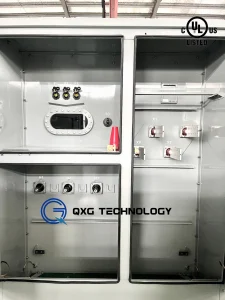
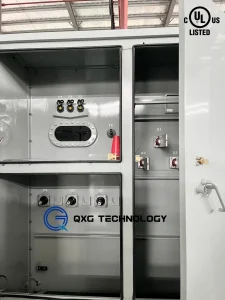
Traditionally, checking a transformer’s internal condition required opening the enclosure—a process that could introduce safety risks and contamination. To address this, our advanced pad-mounted transformers now feature a rugged viewing window, offering instant visual access to internal components without the need for opening the enclosure. This high-visibility design allows operators to quickly check oil levels, inspect critical parts, and detect potential issues—reducing downtime and improving safety. By minimizing unnecessary cabinet openings, this smart upgrade extends equipment lifespan, lowers maintenance costs, and enhances operational reliability—all while keeping personnel safer.
This enhancement is especially valuable in utility operations and industrial environments, where rapid visual checks can prevent minor issues from becoming costly outages.
Advantages of Pad Mounted Transformers
Pad-mounted transformers provide several benefits over other transformer types:
Aesthetic Integration: Their ground-level, enclosed design blends well with landscaped environments, making them suitable for residential and commercial settings.
Public Safety: Lockable steel housings prevent accidental contact with high-voltage parts.
Operational Flexibility: They can handle various voltage levels, serving both small residential blocks and large industrial sites.
Durability: Built to withstand harsh weather and environmental conditions.
Ease of Access for Utilities: Although locked for public safety, authorized personnel can quickly access the units for testing, switching, or repair.
Applications in Power Distribution
You will find pad-mounted transformers in many settings, including:
Residential Neighborhoods: Supporting underground utility networks that eliminate the need for overhead lines.
Commercial Developments: Powering shopping centers, office complexes, and schools.
Industrial Facilities: Supplying stable voltage to heavy machinery and plant equipment.
Renewable Energy Projects: Connecting wind or solar farms to local grids.
Conclusion
Pad-mounted transformers are more than just a hidden box in a neighborhood—they are critical to ensuring that electricity flows safely and reliably to end users. By stepping down high voltage from underground distribution networks to usable levels, they enable efficient power delivery in modern infrastructure. With innovations like built-in rugged viewing windows, maintenance is becoming safer and faster, reducing downtime while extending the operational life of the equipment.
A well-designed pad-mounted transformer isn’t just a passive piece of equipment—it’s a cornerstone of a dependable and secure electrical distribution system.